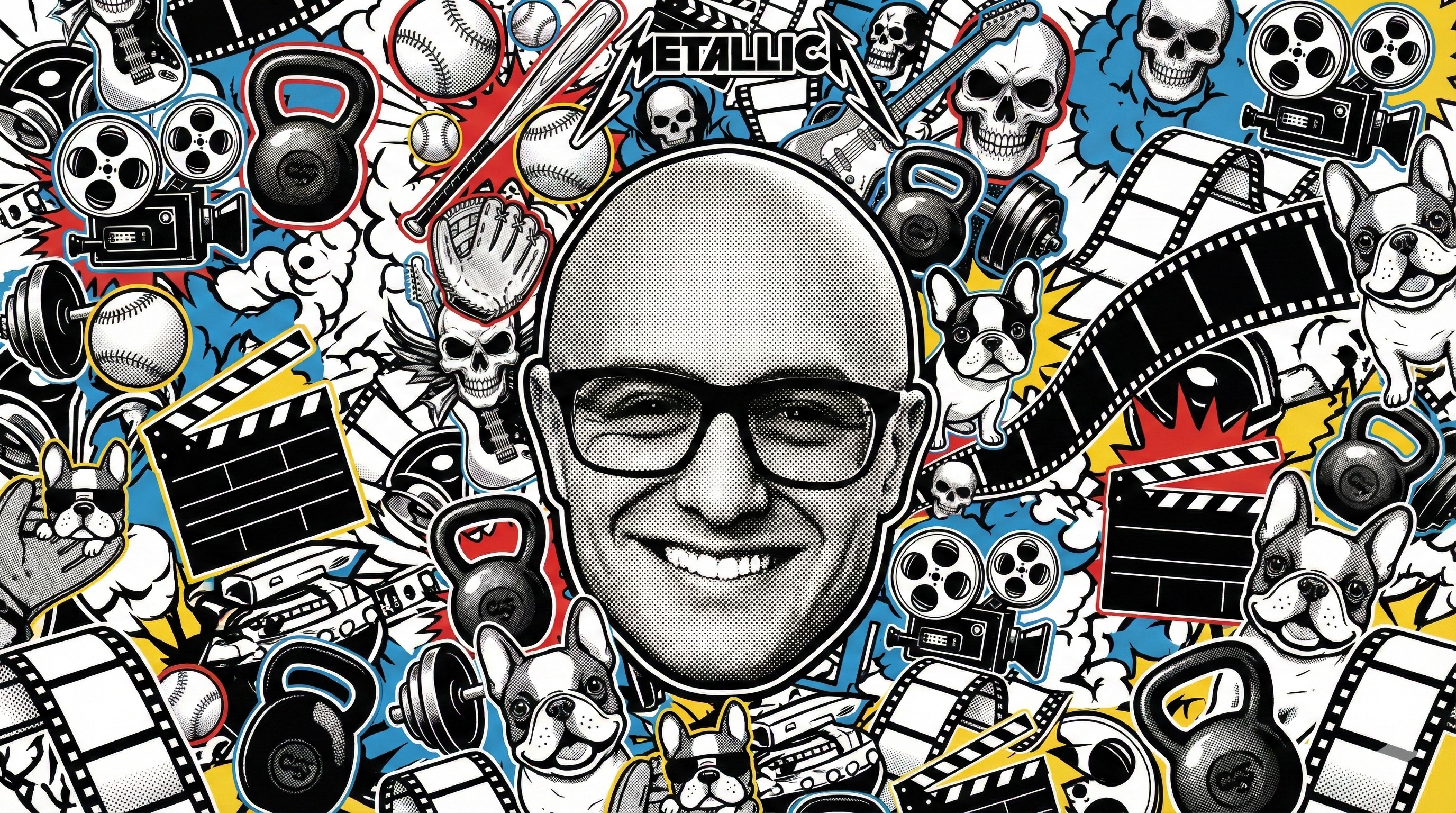

Pablo Vizcaino: Design Project Manager
Recent Blog Posts
How I Work
I turn chaotic requirements into clean Linear/Jira workflows.
I speak both 'Figma' and 'React,' preventing handoff friction.
I measure success in conversion rates and cycle times, not just aesthetics.
What can Pablo do?
- Architect Dual-Track Workflows: I set up parallel work streams (Discovery vs. Delivery) so Design never blocks Engineering, and Engineering never waits for specs.
- Translate "Legal" into "Product": I navigate strict compliance constraints (GDPR, Biometrics) and turn them into clear technical requirements without stalling the roadmap.
- Optimize Ticket Velocity: I transform vague Slack requests into atomic, actionable Linear/Jira tickets with clear acceptance criteria.
- Manage Remote Squads: I lead cross-functional teams (Design, Eng, Data) across time zones, keeping standups short (12 mins) and output high.
- Scope Cutting with Precision: I know exactly which features to cut to hit a deadline without breaking the core user experience or design intent.
- Protect Design Fidelity: I institute "Design QA" gates in the release pipeline, ensuring what ships matches the Figma file pixel-for-pixel.
- Broker Design/Dev Peace: I mediate the classic "Animation vs. Performance" conflicts by finding technical compromises that satisfy both users and APIs.
- Systemize Handoffs: I build the "Bridge" between Figma and Storybook, reducing frontend rework caused by misinterpretation of specs.
- Scale Design Systems: I move teams from "custom CSS for everything" to reusable component libraries that speed up future builds.
- Drive Metric-Based Iteration: I don't just ship; I measure. I use Amplitude/Mixpanel to identify drop-off points (like a 75s verification flow) and fix them.
- Scale Experimentation Velocity: I build workflows that allow teams to run more tests (A/B, multivariate) per month without increasing headcount.
- Risk Management: I anticipate bottlenecks (API latency, 3rd party downtimes) and build "fallback UIs" into the specs before they become emergencies.
- Stakeholder Translation: I translate complex technical blockers into business language for executives, and business goals into technical tasks for engineers.
Featured Case Study
Unfamiliar.id: The Architecture of a Rescue
B2B Identity • AI Integration • Dual-Track Agile

Work History


The Architecture of a Rescue
Orchestrating a 76% reduction in identity verification time by bridging the gap between Legal constraints, AI bias, and Design ambition.
#ProductOps #DualTrackAgile #AI #CrisisManagement · 8 min read
Led a 9-person cross-functional squad (Design, FE Dev, Data) delivering enterprise Identity Verification flows.
Key Achievements
- Orchestrated the "Selfie Capture" overhaul, reducing end-to-end verification time from 75s → 18s while adhering to strict UK biometric compliance laws.
- Increased verification pass rates from 82% to 94% by coordinating a "Lighting Resilience Sprint" that retrained ML models for low-light edge cases.
- Rebuilt the delivery architecture using "Dual-Track Agile," separating compliance blockers from UX iterations, which reduced rework by 40%.
- Cleared a 230+ ticket backlog in Q1 2024 by instituting 12-minute "micro-standups" focused exclusively on unblocking engineering dependencies.
- Scaled experiment velocity from 2 to 6 tests/month, resulting in a 42% reduction in user drop-off during the onboarding phase.
The Perfect Storm
In the world of Identity Verification (IDV), speed is the only metric that matters. Every second a user spends taking a selfie or scanning a passport is a second they might quit.
At Unfamiliar.id, our numbers were bleeding. Our "Selfie Capture" flow—the critical moment where a user proves they are human—was taking 75 seconds. The industry standard was under 30. We were losing 18% of our users at the very last step.
But the problem wasn't just "make it faster." It was a three-front war:
- The Legal Front: UK biometric compliance laws were shifting monthly. Every time we tried to optimize the UI, Legal would freeze the roadmap to audit for new "liveness detection" standards.
- The Technical Front: Our AI model had a severe "low-light bias." It worked perfectly in our brightly lit office but failed 40% of the time when users were in dim rooms, forcing them to restart the process.
- The Cultural Front: Our Design team wanted a high-fidelity, animated "futuristic" experience. Our Engineering team argued that the heavy animations were killing frame rates on older Android devices, which made the AI fail even more.
We were gridlocked. Legal blocked Product. Product pushed Design. Design fought Engineering.
Act 1: Decoupling the Machine (The Legal Fix)
The first step was to stop the bleeding caused by regulatory freezes. We couldn't control the law, but we could control how we reacted to it.
I realized we were treating "Compliance" and "User Experience" as the same ticket. If Legal needed a backend change, we paused frontend work. This was a structural error.
I re-architected our delivery pipeline into Dual-Track Agile:
- Track A (The Infrastructure): This was a 6-week, waterfall-style cycle dedicated to Compliance and Backend API stability. It had strict requirements and zero scope creep. Legal could audit this track without stopping the rest of the team.
- Track B (The Experience): This was a 2-week, rapid-iteration agile cycle for the Frontend and Design teams.
The Impact: We liberated the UI team. They could now iterate on the "Selfie" screen's instructions and animations every two weeks, regardless of whether Legal was auditing the backend database.
Act 2: The Bias in the Machine (The Technical Fix)
With the workflow unblocked, we tackled the drop-off rate. Amplitude data showed a massive spike in failures between 6 PM and 6 AM. The diagnosis was simple: Darkness.
Our AI needed light to see depth. If a user was in a dim room, the AI would silently fail, loop, and eventually time out.
Design wanted to add a "Turn on the lights" error message. Engineering wanted to retrain the model. Both would take too long separately.
I coordinated a "Lighting Resilience Swarm."
- I pulled two ML engineers and one UI designer out of the roadmap for a focused 10-day sprint.
- The Compromise: Instead of waiting 3 months for a perfect AI model, we built a "UI Bridge." The frontend would detect the lux (brightness) value of the camera feed in real-time. If it dropped below a threshold, the UI would pause the capture and trigger a specific overlay: "Screen Flash Mode."
- We used the phone's own screen brightness to illuminate the user's face, bypassing the need for a flash.
The Impact: This "hack" bought us time to retrain the model properly. Pass rates in low-light conditions jumped from 50% to 92% overnight.
Act 3: The Peace Treaty (The Cultural Fix)
Finally, we had to solve the speed issue. The flow was still sluggish on older phones. The engineers blamed the Designers' complex particle animations. The Designers blamed the engineers' unoptimized code.
I stepped in as the mediator, but I brought data, not opinions.
We implemented a "Performance Budget." We agreed that the entire verification flow had to load in under 200ms on a 3-year-old device. I set up a "Device Lab" (using BrowserStack) where we tested the animations on the lowest-end phones our users actually owned.
The results were undeniable. The fancy particles were costing us 15 frames per second.
Seeing the data, the Design team voluntarily cut the heavy animations. In exchange, I worked with Engineering to implement LottieFiles, allowing for lightweight, vector-based micro-interactions that preserved the "premium feel" without the performance tax.
The Outcome
By addressing the structural (Legal), technical (AI), and cultural (Design/Dev) bottlenecks simultaneously, we achieved what seemed impossible:
- Speed: End-to-end verification dropped from 75s → 18s.
- Revenue: The pass rate (successful sign-ups) increased from 82% → 94%.
- Efficiency: By using Dual-Track delivery, we eliminated the "stop-and-start" delays caused by Legal, increasing our shipping velocity by 33%.
The Operational Upgrade (For Your Team)
- Don't let Compliance kill Velocity. If you are in a regulated industry, separate your "Safety" work from your "Discovery" work. Don't let a backend audit stop a frontend experiment.
- Data resolves culture wars. When Design and Engineering fight, don't mediate with feelings. Mediate with a "Performance Budget" or user data.
- Solve the User's problem, not the Tech's problem. We didn't fix the low-light AI immediately; we fixed the User's lighting. Sometimes the best engineering solution is a design intervention.
Final Key Takeaway
High-stakes delivery isn't about perfectly managing a Gantt chart; it's about identifying the invisible dependencies—legal fear, technical bias, and departmental ego—and re-architecting the workflow so they can coexist without collision.
How I Grew at This Role
This project moved me from being a "Process Manager" to a "Product Architect." I learned that to deliver truly complex products, you cannot just stay in your lane. You have to understand the law well enough to debate Legal, understand the model well enough to challenge Engineering, and understand the user well enough to empower Design.
The Psychology of Momentum
Lessons learned in unblocking stalled enterprise launches by managing anxiety, not just schedules.
#Operations #Psychology #Agile #Leadership · 4 min read
Why Projects Stall (It's Not About Resources)
In project management, we often confuse "motion" with "progress." Tickets move from To Do to In Progress, Slack channels buzz, and budget burns. Yet, the product doesn't ship.
I encountered this recently with a major enterprise client. On paper, the project was green. In reality, it was paralyzed. We were trapped in what I call the "Approval Loop of Death." Stakeholders wouldn't sign off on designs until they saw code, but wouldn't authorize code until they signed off on designs.
The blockage wasn't technical. It was psychological.
The "Big Bang" Fallacy
Stakeholders often fear approval because it feels permanent. When we ask for a "Full Page Sign-off," we are asking them to bet their reputation on a static image. Their natural defense mechanism is to stall—to ask for "one more tweak" to delay the risk of being wrong.
To unstick the project, I stopped managing the schedule and started managing the anxiety.
The Solution: Micro-Commitments & Radical Transparency
We made two operational shifts:
- Micro-Approvals: We stopped asking for permission to build the whole thing. We broke approvals down to the component level. "Do you approve this header?" is a low-risk question. "Do you approve this Homepage?" is a high-risk question. Getting a "yes" on small things creates a dopamine loop of momentum.
- The Live Demo Ritual: We killed the slide decks. Every Friday, we demoed the build live—bugs and all.
When the client saw the product breathing in the browser, their anxiety vanished. They weren't looking at a hypothetical risk anymore; they were looking at tangible progress.
The Operational Upgrade (For Your Team)
If your project is stalled, stop adding resources. Look for the fear.
- Don't hide the mess. Show work early. Transparency builds trust faster than perfection.
- Shrink the ask. If you can't get approval on the mile, get approval on the inch.
Final Key Takeaway
Progress is psychological; if you can reduce the stakeholder's fear of approval, you automatically increase the team's velocity of delivery.
How I Grew at This Role
I learned that a Project Manager's job isn't just to update the Jira board—it is to manage the emotional state of the room. I shifted from being a "Schedule Keeper" who nagged for dates to a "Confidence Builder" who created safety for decision-making.
The Subjectivity Trap
Lessons learned in scaling creative output by replacing ego with evidence and systems.
#DesignSystems #Scalability #DecisionScience · 5 min read
How to Scale Creativity (By Killing Ego)
There is a romantic idea that "Process" kills "Creativity." Designers often fight systematization because they fear becoming assembly-line workers. But after managing a suite of four web apps that looked like they were built by four different companies, I learned the opposite is true:
A lack of systems doesn't make you creative. It just makes you tired.
At Goliath, our design reviews were battlegrounds. We argued for hours over button radiuses and shades of blue. These debates were fueled by the Subjectivity Trap—the belief that "good design" is a matter of opinion rather than a function of objectives.
System Thinking as a Peace Treaty
We needed to move from "Art" to "Architecture." I championed a Design System not to constrain the team, but to liberate them from the boring decisions.
We employed a "Trojan Horse" strategy. We didn't stop production to build a system (which no executive will approve). Instead, we componentized as we shipped. If a ticket required a form, we didn't just build that form; we built a reusable <Input /> component. We paid the tax upfront to buy speed later.
Data as the Tie-Breaker
When the Subjectivity Trap resurfaced (e.g., "I feel like this layout is better"), we stopped arguing and started testing. We used A/B tests to let the user decide.
The result? A 40% lift in digital revenue. Not because the buttons were prettier, but because the team stopped fighting over pixels and started solving user problems.
The Operational Upgrade (For Your Team)
- Standardize the boring stuff. If you are still designing "Submit" buttons from scratch, you are wasting brain power.
- Democratize the "Why." Use data to settle disputes. When "My Opinion" vs. "Your Opinion" becomes "What the Data Says," the ego leaves the room.
Final Key Takeaway
Scalability requires trading the short-term freedom of "custom design" for the long-term velocity of "system thinking."
How I Grew at This Role
I transitioned from a designer who defended "art" to a product leader who builds "architecture." I stopped seeing constraints as enemies and started seeing them as tools for speed, realizing that true creativity is solving the problem within the box, not ignoring the box entirely.
The Difference Between a Vendor and a Partner
Lessons learned in rescuing at-risk portfolios by aligning product features with business revenue.
#CustomerSuccess #Growth #Strategy #B2B · 4 min read
Why "Silent" Clients are the Most Dangerous
In the subscription economy, we are trained to fear the angry customer. We monitor support tickets and negative emails like hawks. But in my experience managing a $3.2M portfolio, the angry customer is usually fine. They are engaged. They care.
The customer you need to fear is the silent one.
I had a major retail account that was "Green" on every dashboard. They paid on time. They didn't complain. But they were slowly dying. They treated our platform as "shelfware"—expensive tech they bought but didn't integrate into their daily workflow.
The Vendor vs. Partner Gap
Vendors sell features. Partners sell outcomes.
- The Vendor says: "Here is how our new dashboard works."
- The Partner says: "I see in your quarterly report that you need to grow E-comm sales by 10%. Here is how we are going to help you hit that number."
I realized I had been acting like a Vendor. To save the account, I had to pivot.
The Value Map
I stopped doing "Check-in" calls. Instead, I audited their public financial reports. I mapped every tool in our platform to a specific business goal they had publicly stated.
When I presented this Value Map to their VP, the dynamic shifted immediately. We weren't a cost center anymore; we were a revenue driver. They didn't just renew; they expanded the contract by 15%.
The Operational Upgrade (For Your Team)
- Silence is not safety. If a client isn't talking to you, they are talking to your competitor.
- Stop selling features. Nobody cares about your software update. They care about their bonus. Map your work to their wins.
Final Key Takeaway
Clients don't buy software; they buy the business outcomes that software promises to deliver.
How I Grew at This Role
I evolved from a support-focused mindset to a strategic one. I learned to speak the language of executives (ROI, Growth, Risk) rather than just the language of users (Features, Bugs, Tickets), which allowed me to turn transactional relationships into strategic partnerships.
From Pixel-Perfect to Process-Perfect
Experience
▶
UNFAMILIAR.ID
- Led a 9-person cross-functional team (Design, FE Dev, BE Liaison, Product Analytics) delivering core identity-verification experiences used by enterprise clients.
- Owned roadmap execution across SDKs, dashboards, and onboarding flows; shipped features with 90%+ on-time delivery.
- Directed the end-to-end build of the AI Biometric Selfie Capture + Anti-Spoofing flow — reduced verification time from 75s → 18s and increased pass rate from 82% → 94%.
- Rebuilt delivery processes: introduced dual-track development, compliance-locked sprint windows, and design QA gates, resulting in a 40% reduction in rework.
- Cleared 230+ Jira tickets in one quarter; cut average cycle time by 33% with streamlined workflows.
- Ran 6+ monthly growth experiments, improving onboarding completion by 20% and reducing selfie flow drop-off by 42%.
- Standardized alignment across Legal, Growth, and Engineering through unified requirements and risk frameworks.
▶
OUTLIANT
- Reduced average project delivery timeline by 25% by streamlining design workflows and enforcing stricter acceptance criteria across design and engineering teams.
- Elevated Client NPS by 5 points for enterprise accounts (including SelectQuote and OrangeTheory) by establishing transparent roadmap reporting and weekly delivery demos.
- Managed resource allocation for multiple simultaneous creative projects, ensuring 100% on-time delivery for Q3 and Q4 deliverables.
▶
GOLIATH
- Built and maintained a scalable design system that supported 4 major web applications, directly contributing to a 40% lift in digital revenue.
- Bridged the gap between creative and technical teams, translating complex business requirements into high-fidelity prototypes that secured stakeholder buy-in early in the development cycle.
- Drove 15% customer growth by iteratively testing and optimizing core user flows based on live analytics data.
▶
BLOOMREACH
- Managed a $3.2M ARR portfolio, growing revenue by 15% in 6 months through strategic account planning and product adoption initiatives.
- Reduced churn by 30% for key accounts (Levi’s, Puma) by implementing a proactive customer feedback loop that directly informed the product roadmap.
The Tech Stack
- Linear
- Jira
- Notion
- Figma
- Storybook
- Amplitude
- Mixpanel
- SQL (Basic)
Ready to ship?
Currently available for Senior DPM roles in the UK/Remote.
Social Proof
Blog
Thoughts on design, project management, and building products.